Electric Heavy-Duty Transport: From Pilot Project to Nationwide Fast-Charging Network
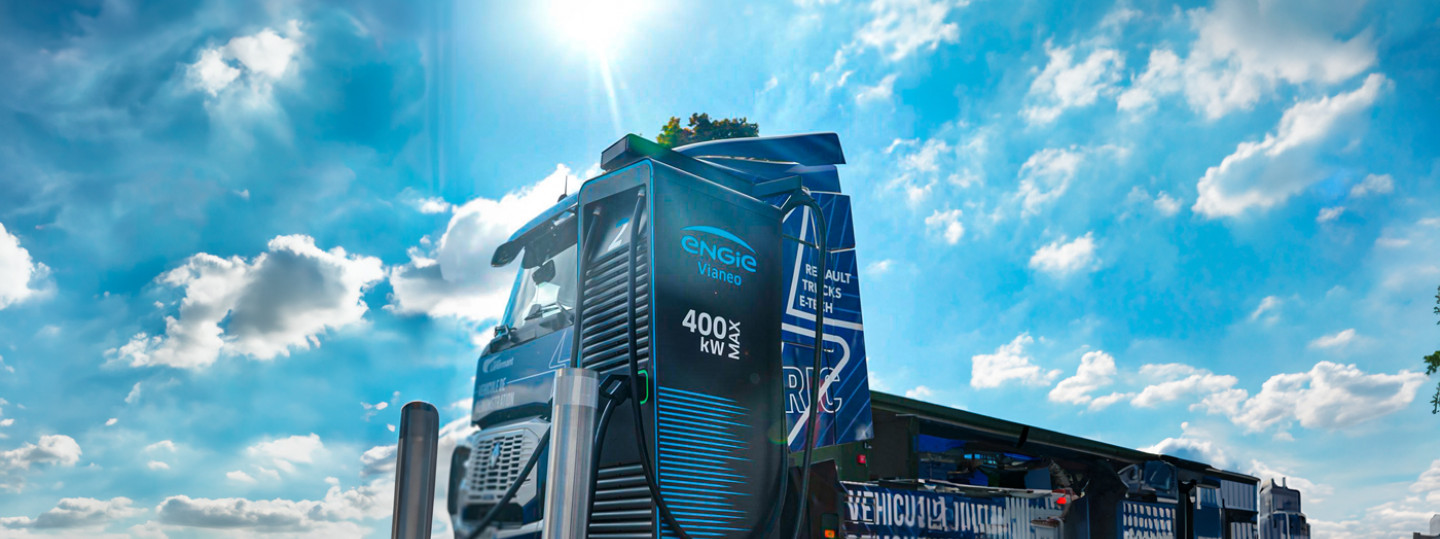
Anyone looking to electrify their truck fleet needs planning certainty. Just a few years ago, the necessary charging infrastructure was lacking in many places. In the meantime, the nationwide rollout of a European fast-charging network has already begun, laying the groundwork for the market ramp-up of electric heavy-duty transport. ENGIE Vianeo is actively shaping this expansion and developing charging infrastructure for electric trucks along highways, at logistics hubs, and in ports.
The market ramp-up has begun
Several developments are currently driving the market ramp-up of electric heavy-duty transportation: The EU’s “Alternative Fuels Infrastructure Regulation” (AFIR) sets binding requirements for the expansion of charging infrastructure. At the same time, the range of electric trucks is growing, and more logistics companies are accelerating the decarbonization of their fleets—in part to reduce their dependence on fluctuating oil prices.
“We are currently in a phase where we are transitioning to a nationwide rollout,” says Alina Haller, Head of Business Development & Sales at ENGIE Vianeo Germany. “In recent years, the focus has primarily been on pilot projects. Now, this is turning into a genuine market ramp-up.”
As part of the nationwide expansion of fast-charging infrastructure for heavy-duty vehicles by the federal government and Autobahn GmbH, ENGIE Vianeo has been awarded the contract for the Southeast lot. The area covers major highway corridors in southeastern Germany and, with 26 locations, constitutes the largest lot in this tender. A total of 173 charging points will be installed, including 105 based on the Megawatt Charging System with 1,000 kilowatts.
“For us, winning this contract is a huge milestone. We’ve been expanding our business into the German market for over a year now. The fact that we’ve already secured such a large project is a major success for us. It’s also a ‘One ENGIE’ success, as we’ve received support from many colleagues beyond ENGIE Vianeo Germany,” reports Alina Haller.
More Than Just Charging Stations on the Highway
Charging points along highways are key building blocks for electrified long-distance transportation. However, from the expert’s perspective, a functioning fast-charging network can only be created through the interplay of various locations.
“Success comes from the combination of charging points at truck stops, depots, logistics centers, industrial parks, and ports,” she explains. In addition to charging parks with high charging capacities for transit traffic, charging infrastructure is needed wherever trucks have longer layovers anyway. “Especially at ports, trucks often have a certain amount of waiting time before their cargo is shipped. That’s why it makes sense to set up charging infrastructure there,” she explains. Only this combination can bring about a comprehensive transportation transition for commercial vehicles.
One example of this is the ENGIE Vianeo charging park in the Port of Kiel, which began operations in August 2026. Additional port projects are in the planning stages.
MCS: The Technology of the Future for Long-Haul Transport
MCS charging technology plays a major role in long-haul transport with electric trucks. “We’re excited that we can now roll out this innovative technology,” says Alina Haller. “Because, of course, the higher the charging power, the faster trucks can be recharged while in transit, and the faster the vehicles reach their destination. However, to ensure that vehicles without megawatt technology can also use the infrastructure, we’re planning our locations today so that many MCS charging stations also have CCS charging plugs available,” explains the expert.
This allows the charging parks to be operated economically while also being prepared for the requirements of the next generation of vehicles.
Energy Industry Expertise Breaks Down Barriers
The technology is now well developed. The path to grid connection, however, is often more challenging. “Grid connection is really almost always the most critical path,” says Alina Haller. However, because this often sets the pace for a project, ENGIE Vianeo coordinates closely with grid operators as early as the planning phase and draws on the ENGIE Group’s energy industry expertise. The goal is to identify potential bottlenecks early on and implement projects as efficiently as possible.
The backing of the ENGIE Group makes a significant difference for ENGIE Vianeo, as Alina Haller explains: “We have the advantage of being an energy company and being able to contribute our energy expertise. At the same time, we’re a global corporation. That means our goal of building a European network is practically in our DNA. Likewise, we’re designing everything to be scalable: We’re already planning tomorrow’s charging parks today. This ensures our charging parks are future-proof.”
ENGIE Vianeo: A Holistic Strategy Instead of Isolated Charging Points
For ENGIE Vianeo, the mission doesn’t end with installing individual charging stations. “Our approach is different from that of a pure charging-point operator,” Alina Haller clarifies. As part of the ENGIE Group, ENGIE Vianeo can combine expertise in photovoltaics, battery storage, energy trading, and charging infrastructure. This systemic approach is becoming increasingly important, especially considering limited grid capacity.
The experience the company has already gained in other European markets is invaluable. In Europe, ENGIE Vianeo operates more than 11,000 charging points, including around 900 on highways. Projects such as the fast-charging corridor between Lyon and Paris or multi-energy stations that combine charging infrastructure with photovoltaics and biogas serve as blueprints for further expansion in Europe. In late 2025, Jan-Niklas Ellerich, Managing Director of ENGIE Vianeo in Germany, explained in ENGIE Deutschland Magazine how these experiences accelerated the company’s market entry in Germany and what role smart energy concepts play in this process.
Alina Haller also sees the company’s international presence as an advantage. This is because ENGIE Vianeo Germany can draw on the company’s experience in countries such as France and Belgium. This expertise is directly applied to the development of a Europe-wide fast-charging network for commercial vehicles. In the future, ENGIE Vianeo aims to support transportation companies across borders with a uniform standard of quality and service.
Germany as a Hub in the European Fast-Charging Network
"Germany definitely plays a key role in the development of the European charging network because a large portion of European transit traffic passes through our country," says Alina Haller.
An efficient charging network is therefore important not only for German freight forwarders but for the entire international freight transport sector.
At the same time, pressure is mounting on the industry to make transportation more climate-friendly. According to the expert, sustainability requirements and ESG criteria will further accelerate the expansion of the charging infrastructure and increasingly make electric trucks a competitive factor.
European Fast-Charging Network: From Infrastructure Project to Energy Transition
The expansion of the charging infrastructure creates the conditions for companies to gradually electrify their fleets. The direction is clear: coordinated, ambitious projects are gradually giving rise to a Europe-wide network. This involves far more than just building charging stations. What is crucial is a reliable interplay between energy supply, smart infrastructure, and international connectivity. This is precisely where ENGIE Vianeo’s contribution to the mobility transition lies.
Our Expert

Articles you might also be interested in

Data Centers as System Partners of the Energy Transition: Flexibility, Heat, and Renewable Energies
Why decarbonization only works as a system
Decarbonization only works as a system: Eric Stab explains why individual measures are not enough and why integrated solutions are essential.
How Power Purchase Agreements (PPAs) are becoming key to climate neutrality
Green Power PPAs Drive Industrial Decarbonization: An Overview of Opportunities, Challenges, and Regulatory Frameworks.
"Downtime Becomes Charging Time" – How PORT OF KIEL is Electrifying Heavy-Duty Transport with ENGIE
How the PORT OF KIEL is expanding charging infrastructure for electric trucks with ENGIE: 400 kW fast charging, AFIR targets, and the future of electric heavy-duty transport.

Impulse #28: The Energy Transition Requires Systems Thinking
Energy policy requires systemic thinking: Eric Stab from ENGIE Germany explains how international experience can advance the German energy transition. Read now!

A decade of change: ENGIE and the path to energy transition
150 years of history, 10 years of ENGIE: a look back at history, people, and the ambition to make the energy transition and climate neutrality measurable.
How data centers actively support the energy transition
Data centers are becoming energy hubs and playing a key role in the energy transition. Discover the opportunities.
Power for heavyweights – How ENGIE Vianeo is driving forward electric mobility for trucks
Find out how ENGIE Vianeo is accelerating truck electromobility in Europe.

Impulse #27: Tackling decarbonization
Taking action on decarbonization: Niklas Wiegand from ENGIE Germany blogs about sustainable solutions for cities, industry, and buildings. Read now!
Biomethane – making energy supply climate neutral
Biomethane can make industry, heat supply and mobility more climate-friendly. Read more about this underestimated energy source.