
Data Centers as System Partners of the Energy Transition: Flexibility, Heat, and Renewable Energies
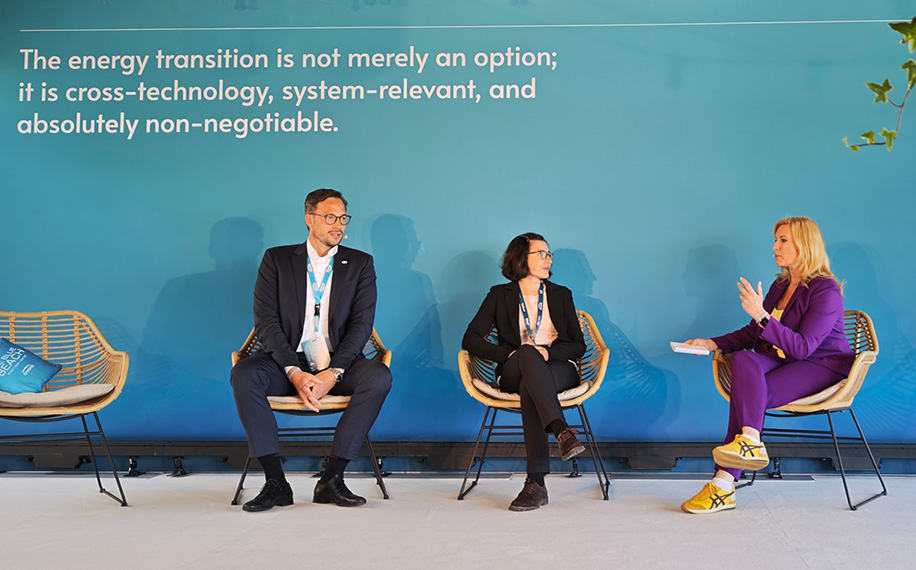
Data centers are often primarily regarded as major electricity consumers. At THE BLUE BEACH, Hamburg’s summer festival for systemic energy transition, Microsoft’s Ginevra Guzzi and ENGIE’s Tobias Heyen discussed why they must increasingly be understood as part of the energy system: they can utilize renewable energies, make unused heat available, and provide grid services.
“Thinking Digitalization and Energy Transition Together“
In discussions, data centers are often reduced to the topic of electricity consumption. Isn’t that too narrow?
Ginevra Guzzi: “When we talk about data centers, we should first take a step back and ask what they are actually for. They have long been an integral part of our daily lives and enable applications ranging from mobile services to the control and planning of critical energy infrastructure. Many of the tools that advance the energy transition – such as vegetation management or dynamic line rating – rely heavily on data processing in data centers. At the same time, the infrastructure of data centers itself opens up new possibilities.“
Tobias Heyen: “That’s exactly where the next development step lies. In the future, data centers will also be part of the energy transition with their infrastructure. Battery storage, emergency power systems, or other technical facilities on-site can provide additional flexibility and thus support the integration of renewable energies. This way, data centers are increasingly evolving from electricity consumers to active system partners of the energy transition.“
Unused Heat: Great Opportunities, but Not Everywhere
This raises another question that is frequently asked in public debates about data centers: What happens to the heat generated – and how can it be used meaningfully?
Ginevra Guzzi: “The potential of data center heat is significant, but implementation is more complex than often assumed. Together with an energy partner in Scandinavia, we realized one of the largest projects for utilizing this heat. The challenge begins with the temperature level: heat from data centers typically lies around 30 degrees and must be raised to a level usable for district heating networks using heat pumps. At the same time, suitable local infrastructure is needed, because the heat can only be used if there is an appropriate district heating system and, above all, a customer for it. That’s why the success of such projects always depends on local conditions – technically, economically, and infrastructurally.“
Tobias Heyen: “The use of heat from data centers is still rather a niche topic. Together with partners, we are currently implementing a project in the Berlin district Das Neue Gartenfeld where a newly built residential area is being heated with the heat from a nearby data center. However, such concepts cannot be transferred arbitrarily. The use of data center heat must always be considered together with regional infrastructure.“
Grid services Instead of Just Power Consumption
What role can data centers play in stabilizing the grid and increasing flexibility of the energy system?
Ginevra Guzzi: “This question is currently being intensively discussed. In Ireland, we have shown that it is fundamentally possible: there we make the batteries of our UPS systems interact with the power grid and provide grid services where feasible. Such solutions can make an important contribution to grid stability. However, a market and regulatory design is required that allows this use, while also taking into account the high requirements for supply security of our customers. How much flexibility a data center can provide therefore always depends on what applications are operated there and what obligations exist toward users.“
Tobias Heyen: “For me, the discussion goes even one step further. Many new data center projects today are hitting limits with grid connections because the required capacities cannot always be fully provided. That’s why integrated energy solutions are gaining importance – such as battery storage, flexible generation systems, or other systems that can complement and secure operations. This opens up new possibilities to not only supply data centers with energy, but to plan them from the start as part of a more flexible energy system. Depending on location and application, this can create additional flexibility for the power system.“
The Next Generation of PPAs
What does this development mean for Power Purchase Agreements – and how must they evolve to meet the future requirements of data centers?

Ginevra Guzzi: “PPAs remain an important instrument for decarbonization. At the same time, they must evolve. The classic vanilla PPA model of a long-term fixed-price contract for a single generation project will not always be sufficient in the future. We need to think more in terms of portfolios and partnerships rather than individual assets.“
Tobias Heyen: “In the future, hybrid models will become more important, as will proof that generation and consumption occur simultaneously. Wind and solar complement each other. Storage is gaining importance. Additionally, we need flexibility options to better align consumption and generation, up to 24/7 carbon-free energy. From an energy economics perspective, this is an important shift in perspective. Because the challenge of the energy transition is not just about building more renewable energy. What’s crucial is also how we make this energy available when it’s needed.“
The Location Question Becomes an Energy Question
For a long time, the rule was: data centers are built where customers and land are available. Today, a different question is taking center stage: where is there sufficient energy for digital growth?
Ginevra Guzzi: “The focus in site selection has changed significantly in recent years. Previously, we mainly looked at where our customers were or where suitable land was available. Today, we follow a power-first approach: the first question is where the power is available. The availability of electricity and the ability to quickly connect new capacities to the grid are now the decisive factors. In order to pursue that, companies, grid operators, and regulatory authorities must work closely together.“
Tobias Heyen: “At the same time, data centers themselves can advance the development of renewable projects. When generation and consumption are more closely linked spatially, grid bottlenecks can be reduced, the integration of renewable energies can be facilitated, and regional value creation can be strengthened.“
More Creativity for the Energy Transition
Looking ahead: How will we recognize in 2040 that data centers have successfully shaped the energy transition?
Ginevra Guzzi: “I would like to see much more creativity in how we think about energy systems. Instead of looking at individual technologies or facilities in isolation, we should think more in terms of solutions and systems. Not every challenge needs to be solved directly at the data center. If private investments help, for example, to advance heat pumps or other decentralized energy solutions in the broader grid region, that can create greater value for the overall system. For me, success would be if we combine existing solutions more intelligently and thereby enable real innovations for decarbonization.“
Tobias Heyen: “For me, success would mean that we have built the data centers we need for a digital future without slowing down investment in renewable energy. The real challenge is no longer a single PPA from a wind farm to a data center. What matters is how we combine offshore and onshore wind, solar, battery storage and other flexibility options into one integrated solution. If we can manage that complexity and create real value both for data centers and for the wider energy system, then we have succeeded.“
Articles you might also be interested in
Electric Heavy-Duty Transport: From Pilot Project to Nationwide Fast-Charging Network
Why decarbonization only works as a system
Decarbonization only works as a system: Eric Stab explains why individual measures are not enough and why integrated solutions are essential.
How Power Purchase Agreements (PPAs) are becoming key to climate neutrality
Green Power PPAs Drive Industrial Decarbonization: An Overview of Opportunities, Challenges, and Regulatory Frameworks.
"Downtime Becomes Charging Time" – How PORT OF KIEL is Electrifying Heavy-Duty Transport with ENGIE
How the PORT OF KIEL is expanding charging infrastructure for electric trucks with ENGIE: 400 kW fast charging, AFIR targets, and the future of electric heavy-duty transport.

Impulse #28: The Energy Transition Requires Systems Thinking
Energy policy requires systemic thinking: Eric Stab from ENGIE Germany explains how international experience can advance the German energy transition. Read now!

A decade of change: ENGIE and the path to energy transition
150 years of history, 10 years of ENGIE: a look back at history, people, and the ambition to make the energy transition and climate neutrality measurable.
How data centers actively support the energy transition
Data centers are becoming energy hubs and playing a key role in the energy transition. Discover the opportunities.
Power for heavyweights – How ENGIE Vianeo is driving forward electric mobility for trucks
Find out how ENGIE Vianeo is accelerating truck electromobility in Europe.

Impulse #27: Tackling decarbonization
Taking action on decarbonization: Niklas Wiegand from ENGIE Germany blogs about sustainable solutions for cities, industry, and buildings. Read now!
Biomethane – making energy supply climate neutral
Biomethane can make industry, heat supply and mobility more climate-friendly. Read more about this underestimated energy source.