The heating transition on a municipal scale: ENGIE Deutschland to take over district heating supply in Sandhausen for 25 years
- ENGIE Deutschland will supply the school complex, the Wirbelwind kindergarten, and the “Große Mühllach I+II” neighborhoods as part of a 25-year energy supply contracting agreement
- The partnership begins on August 1, 2026; starting then, ENGIE Deutschland will reduce CO₂ emissions by approximately 71 percent by 2030 and provide 100 percent renewable heat by 2040
- The initiative is one of the first municipal heating planning projects in Sandhausen and is set to receive federal funding for efficient heating networks
Cologne – ENGIE Deutschland and the municipality of Sandhausen are implementing one of the first projects as part of the municipal heating plan in the region. Under an energy supply contracting agreement, ENGIE Deutschland will take over the local heating supply for the school complex, the Wirbelwind kindergarten, and the “Große Mühllach I+II” neighborhoods effective August 1, 2026. The contract runs for 25 years (2026–2051) and covers the operation, optimization, and gradual decarbonization of the existing heating network, which comprises approximately 300 building connection points and has an annual heat demand of about 6,000 megawatt-hours. Hakan Günes, mayor of the municipality of Sandhausen, says: “Together with ENGIE Deutschland, we are taking concrete steps toward the local heating transition with this project and are focusing on predictability, reliability, and a clear roadmap for the coming decades. For our residents, this means a secure, increasingly climate-friendly heat supply.”
Decarbonization Path with Clear Milestones
At the heart of this forward-looking project is the phased conversion of heat generation: When service begins in 2026, the network will initially be powered by gas. In 2027, ENGIE Deutschland will oversee the construction of a new gas condensing boiler and the development of a transformation plan in accordance with BEW Module 1 (Heat Network Feasibility and Transformation Planning). By 2030, the experts will install a pellet boiler system, which will then account for approximately 80 percent of heat generation. The mix will be supplemented by the gas condensing boiler to cover peak loads and provide redundancy, as well as by a combined heat and power plant to generate electricity for operations. Starting in 2040, the ENGIE Deutschland team plans to convert the gas-dependent generators to biomethane; the heat supply will thus reach a 100 percent share of renewable energy. The impact of ENGIE Deutschland’s measures on emissions is significant: CO₂ emissions will drop from approximately 1,068 metric tons in 2026 to about 310 metric tons in 2030—a reduction of about 71 percent. At the end of the contract term in 2051, ownership of the heat generation facilities will be transferred to the municipality of Sandhausen.
ENGIE Deutschland Combines Heating Expertise and Customer Service
Niklas Wiegand, Managing Director of ENGIE Deutschland GmbH, emphasizes: “In Sandhausen, we’re demonstrating how municipal heating planning is put into practice. At ENGIE Deutschland, we combine technical expertise with extensive financing and funding know-how to support the gradual transition of existing heating networks to 100% renewable energy. As a reliable partner to municipalities, we’re driving the heating transition where it matters most: right there on the ground, among the people.” In Sandhausen, ENGIE Deutschland will take over customer support for the connected households, with the expert team from ENGIE’s nearby Ludwigshafen branch ensuring swift and competent implementation. End customers will gain access to the ENGIE customer portal, which provides transparent consumption and pricing information. Over the course of the contract term, all building connection stations will also be regularly replaced, maintained, and equipped with calibrated, remotely readable heat meters. The project by ENGIE Deutschland and the municipality of Sandhausen is set to receive support through the Federal Funding Program for Efficient Heating Networks (BEW) via both Module 1 (Transformation Plan) and Module 2 (Systemic Funding) and can serve as a model for other municipalities and cities throughout Germany. ENGIE Deutschland is one of the most experienced partners for the municipal heating transition: The specialist in technology, energy, and service operates approximately 100 of its own heating networks nationwide and supports municipalities such as Tettnang—where a local heating network powered by 100 percent renewable energy is currently being developed—on their path to climate-friendly heat supply.
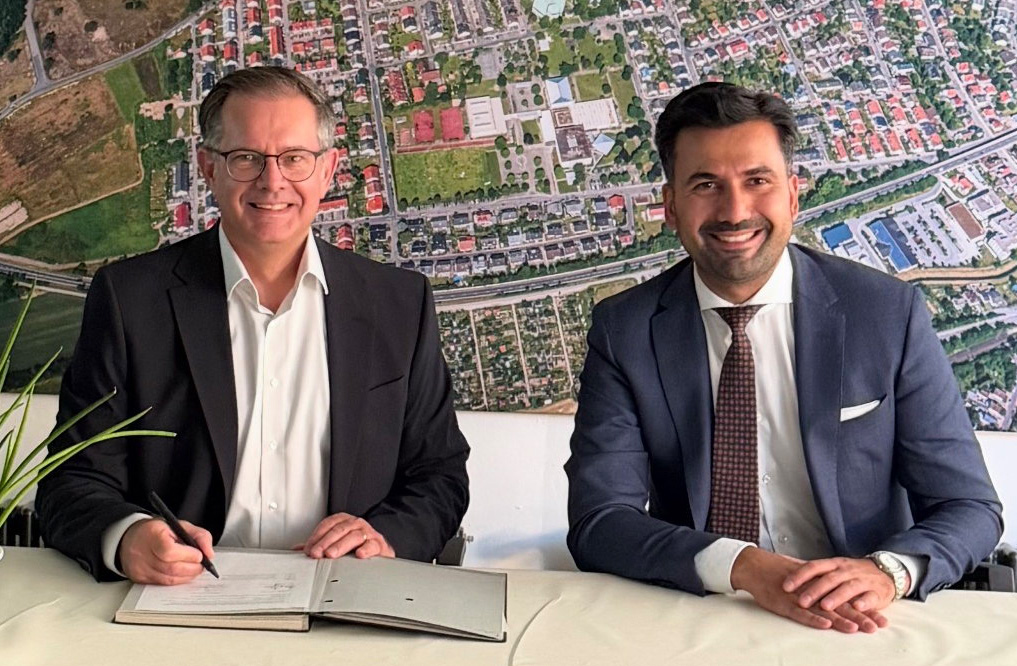
Kick-off for the heating transition in Sandhausen: Niklas Wiegand (left), Managing Director of ENGIE Deutschland GmbH, and Hakan Günes, mayor of Sandhausen, sign the 25-year contract for local district heating.
Your contact
ENGIE Deutschland GmbH